

Table of Contents
- The Real Reasons Graphic Tees Fade Quickly
- How to Wash Graphic Tees Properly (Step-by-Step)
- Best Laundry Detergent for Graphic Tees
- How to Prevent Screen Print Cracking
- How Ink Type and Fabric Quality Affect Longevity
- How to Revive Faded Graphic Tees
- Frequently Asked Questions
Last Updated: September 10, 2026
The Real Reasons Graphic Tees Fade Quickly
Graphic tees fade because the ink layer and the cotton fibers beneath it break down at different rates, and most laundry routines accelerate that breakdown. The culprit is rarely one dramatic mistake, it's the accumulation of small stresses most people never think about.
Fiber abrasion and thermal stress are the two main drivers, and both happen in your washer and dryer, not on the hanger.
Fiber Abrasion and Mechanical Stress in the Wash
Every wash cycle subjects a shirt to friction against other garments, the drum wall, and itself. That friction wears down the cotton fibers, and when fibers fray, the ink on top loses its anchor. Printers call this fiber abrasion, and it's why a crisp design starts to look fuzzy around the edges.
Overcrowding makes it worse: a stuffed drum forces shirts to rub against zippers, buttons, and each other for the full cycle. A common mistake is treating graphic tees like towels, same load, same settings, same heat. They need their own space and cycle.
Thermal Stress: How Heat Damages Print Material
Heat is the second silent killer. Hot water swells and stresses the fabric, and a hot dryer softens the ink until it can stretch, crack, or bond unevenly to the fibers. After repeated high-heat cycles, plastisol or water-based ink loses elasticity and starts to craze.
The fix is simple and cheap: wash cold, dry low or air dry. Thermal stress is cumulative, so every hot cycle you avoid buys your print more life.
How to Wash Graphic Tees Properly (Step-by-Step)
Washing graphic tees properly means turning them inside out, using cold water on a delicate cycle, and skipping the dryer when you can. Follow these steps and most prints will outlast the shirt.
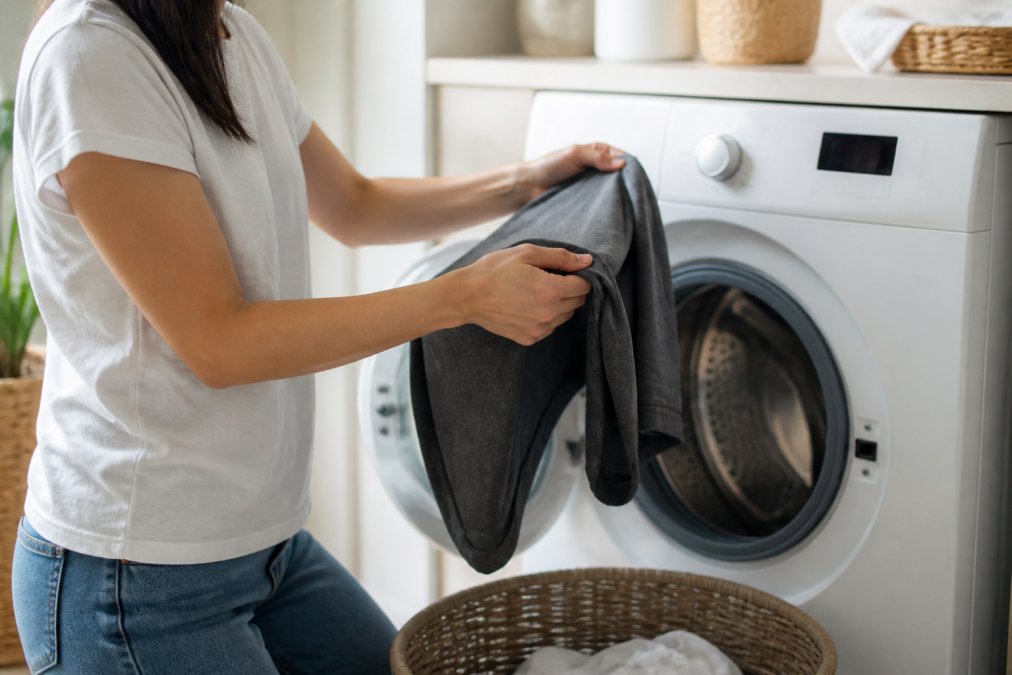
Turn Them Inside Out Before Every Wash
Turning a tee inside out is the single highest-return habit you can build. It puts a layer of cotton between the print and everything else in the drum, cutting friction and protecting the ink from direct abrasion. Do it every time, even on a quick rinse.
Use Cold Water and a Delicate Cycle
Cold water keeps fibers from swelling and ink from softening. Use a delicate cycle with low spin, and resist adding "just one more shirt", a loosely packed drum means less mechanical stress per garment.
Here's the routine that works:
- Turn the shirt inside out and close any zippers on other items.
- Wash with like colors in cold water on a delicate cycle.
- Use a small amount of mild detergent, no bleach, no fabric softener.
- Skip the dryer or use the lowest heat setting.
- Hang or lay flat to air dry, away from direct sunlight.
Best Laundry Detergent for Graphic Tees
The best detergent for graphic tees is a mild, free-and-clear liquid with no bleach, fabric softener, or optical brighteners. These additives make whites pop, but on a printed shirt they attack the ink and leave residue that dulls colors.
Powder detergents can also be a problem: they don't always dissolve fully in cold water, and undissolved granules act like tiny abrasives against the print. Liquid formulas dissolve more reliably at low temperatures.
Why Bleach and Fabric Softener Ruin Prints
Bleach is obvious: it breaks down color and doesn't distinguish a stain from your design. Fabric softener is sneakier, it coats fibers in a waxy film that builds up on the print, trapping dirt and dulling the ink (PubMed). That buildup makes colors look muddy and can cause cracking as the coating flexes differently than the ink.
If you want softer shirts, use wool dryer balls on low heat instead, or add a half cup of white vinegar to the rinse cycle. Both soften fabric without coating the print.
How to Prevent Screen Print Cracking
Screen print cracking happens when ink loses flexibility and can no longer stretch with the fabric. Prevention comes down to low heat, low friction, and room to move.
- Wash cold, always. Heat is the primary cause of ink embrittlement.
- Avoid overcrowding. A full drum means more friction and more stress.
- Never iron directly on the print. If you must iron, turn the shirt inside out and use low heat.
- Fold, don't hang, for storage. Hanging stretches the shoulders and can stress the print over time.
How Ink Type and Fabric Quality Affect Longevity
Not all prints are built the same, and ink type matters as much as laundry habits. Each printing technology bonds to cotton differently, so each fails differently under the same wash cycle.
How Each Ink Type Bonds to Cotton
Plastisol screen print. Plastisol is a PVC-based ink that sits on top of the fabric as a cured plastic film. It resists water and detergent well, but has almost no elasticity, so when the cotton stretches, the film crazes and cracks. That's why screen prints fail by cracking rather than fading.
Water-based screen print. Water-based ink soaks into and dyes the cotton fibers rather than coating them, giving a soft hand-feel and a print that won't crack. But because the pigment sits inside the fiber, abrasion, detergent, and mineral deposits wear the color down from within, so these prints fade gradually instead of failing suddenly.
Direct-to-garment (DTG). DTG lays down a water-based ink plus a white underbase, then cures it. The ink penetrates only the top layer of fibers, so there's no thick protective film and DTG prints are the most vulnerable to fiber abrasion, every wash that fuzzes the cotton takes pigment with it. That's why DTG graphics often look duller after 20-30 washes even when washed correctly (peer-reviewed research).
Vinyl / heat transfer. Vinyl is a plastic film adhered with heat-activated adhesive. It doesn't fade like ink, it peels. The failure point is the adhesive bond at the edges, which is why vinyl graphics lift at the corners first; heat, stretching, and flexing all attack that bond.
Sublimation. Sublimation ink turns to gas under heat and bonds into polyester fibers at a molecular level. On 100% polyester, a sublimated print essentially cannot fade or crack because there's no surface layer to lose. On cotton it doesn't work well, the dye has nothing to bond to, which is why sublimated shirts are almost always polyester.
Why This Changes Your Care Routine
The practical takeaway: the same wash routine is not equally kind to every print. A plastisol screen print can survive years of cold washing, while a DTG print on the same shirt fades faster because the pigment sits in the top layer of fibers. For maximum longevity, screen print on a heavier cotton knit can be a forgiving combination.
Fabric Quality: The Substrate Matters
Fabric quality plays a role too. A denser, heavier cotton knit holds its shape and gives the ink a more stable surface, while thin, loosely knit fabric stretches more in the wash and pulls at the print. Ring-spun cotton, fibers twisted tighter before spinning, abrades more slowly than open-end cotton, which is why a well-made tee with a good screen print can look great for years while a cheap one fades in a season. Fabric weight is a rough proxy: a 5.5-6.5 oz/yd² cotton tee generally outlasts a 4 oz/yd² one, simply because there's more fiber to absorb abrasion before the ink loses its anchor.
Water Hardness: The Factor Nobody Talks About
Water hardness is an underrated factor most care guides ignore. Hard water carries dissolved calcium and magnesium, which can precipitate out during a wash and deposit onto fabric and ink as a chalky film, the same scale that builds up on a showerhead (the EPA). On a print, that film scatters light and makes colors look hazy even when the ink is intact.
Hard water also works against your detergent: minerals react with surfactants and pull them out of solution, so less cleaning power reaches the shirt. You may then compensate with more detergent or hotter water, both of which accelerate print degradation. If your prints fade faster than a friend's on the same routine, your water supply may be the difference. A water softener, a rinse-cycle additive, or a final cold rinse with white vinegar can strip mineral film before it sets.
How to Revive Faded Graphic Tees
Most care guides stop at prevention and never answer the question readers actually have: can this shirt be saved? The answer depends on what failed. Fading, cracking, and peeling are three different problems, and only two are reversible.
Diagnose Before You Treat
Run your thumb across the print and look at it under bright light:
- Dull, hazy color with an intact, smooth surface, this is surface film, not ink loss. Usually reversible.
- Color that's genuinely lighter, with the fabric texture showing through the print, pigment loss. Partially improvable, not fully restorable.
- Visible cracks in a raised, rubbery film, plastisol embrittlement. Not reversible.
- Lifted or curled edges on a smooth plastic graphic, adhesive failure on vinyl. Sometimes re-pressable.
Step 1: Strip the Buildup (Fixes Most 'Fading')
A large share of what people call fading is actually residue, detergent, fabric softener, and mineral film sitting on top of the ink and scattering light. Before assuming the print is dead, strip it:
- Turn the shirt inside out.
- Soak in cool water with a small amount of mild, free-and-clear liquid detergent for 30-60 minutes. Avoid oxygen bleach on colored prints, it can lift dye.
- Add a half cup of white vinegar to a fresh cool rinse to help dissolve mineral film.
- Wash on a delicate cycle, cold, low spin.
- Air dry completely, then compare against a photo of the shirt when it was new.
Many shirts that looked faded come back noticeably after this, because the ink was never the problem, the coating on top of it was.
Step 2: Touch Up Genuine Pigment Loss
If the color is truly gone, you're managing decline rather than reversing it. For simple, solid-color graphics, a fabric marker or paint matched to the original color can fill worn areas, best on large blocks of a single color, poorly on gradients, halftones, or photos. Apply in thin layers, let each dry fully, and heat-set per the marker's instructions, usually a low iron over a protective cloth, never directly on the print.
Step 3: Re-Press Lifted Vinyl Edges
For vinyl graphics peeling at the corners, a low-heat iron or heat press with a protective cloth or parchment over the design can sometimes reactivate the adhesive and press the edge back down. Use low heat, short bursts, and let it cool fully before stretching. This is temporary, once adhesive fails, it tends to fail again, but it can buy a season.
What Cannot Be Fixed
Cracked plastisol is permanent. Once the ink film has lost its plasticizers and crazed, no home method reflows it, and pigment abraded out of cotton fibers can't be put back. Fabric paint over a cracked print looks worse, not better, it fills the cracks unevenly and adds a layer that will fail on its own schedule.
The Realistic Math
Prevention beats restoration every time. A shirt washed cold, inside out, and air-dried can hold its print for years. One that's already lost pigment can improve at the margins, but not return to new. If a graphic tee is a favorite, treat the first wash as the one that matters most, because every cycle after is cumulative.
Frequently Asked Questions
How long do graphic tees last?
Most graphic tees last between 20 and 50 washes before noticeable fading or cracking appears. The biggest factors are print method, fabric quality, and laundry habits. Screen-printed shirts on 100% cotton tend to hold up longer than direct-to-garment or vinyl transfer prints when washed correctly. Turning shirts inside out, using cold water, and air drying can push a well-made tee well past the 50-wash mark.
Does heat cause graphic prints to crack and fade?
Yes. High heat breaks down the ink bond with the fabric, causing prints to crack, peel, or fade. Tumble drying on high heat and ironing directly over the print are the two fastest ways to damage a graphic tee. Air dry when possible, or use the lowest heat setting. If you must iron, turn the shirt inside out and never press the iron directly on the printed area.
How to stop graphic tees from fading?
Wash inside out in cold water on a delicate cycle, use a mild detergent without bleach or fabric softener, avoid overcrowding the machine to reduce friction, and air dry or tumble dry on low. Keep shirts out of direct sunlight when drying, since UV exposure degrades both fabric dye and print ink. These habits together slow fading more than any single change.
How to revive faded t-shirts?
For minor fading, a cold-water soak with a color-safe oxygen booster can brighten fabric dye without harming the print. Avoid chlorine bleach, which strips color and weakens fibers. If the print itself has faded or cracked, fabric markers or a fabric paint touch-up can mask small areas. Severely degraded prints cannot be fully restored, but proper care from the start prevents most fading.
Fading and cracking are the two complaints we hear most from people who've bought pet tees elsewhere, and both come down to care habits and print quality. FurEver Tees builds our graphic t-shirts with designs inspired by real pet relationships, including our dedicated Expression Collection, so the bond you're celebrating lasts as long as the shirt does. Get started with FurEver Tees and find a tee that holds its color through every wash, every walk, and every photo.